Webinar
Clinicians
Thyroid Therapy: Looking Beyond the Labs
Watch on-demand! Belmar Pharma Solutions Preferred Provider webinar: “Thyroid Therapy: Looking Beyond the Labs” Hear from Angela DeRosa, DO, MBA,[...]
Learn more

Learn more about common thyroid disorders that affect women and men and cause symptoms such as fatigue, anxiety, sweating, constipation, mood swings, and weight gain–and how thyroid medications from Belmar Pharmacy can help.
Watch on-demand! Belmar Pharma Solutions Preferred Provider webinar: “Thyroid Therapy: Looking Beyond the Labs” Hear from Angela DeRosa, DO, MBA,[...]
Learn moreNewBeauty® and Belmar Pharma Solutions present, “The 360° Aesthetic: Why Your Patients are Asking for Hormone Optimization” Watch this on-demand webinar to get insight into the most-asked questions[...]
Learn moreAre you ready to learn from the experts? Get answers to the most common questions about Women’s Hormonal Health & Wellness. Watch on-demand, our candid[...]
Learn moreWatch on-demand! Belmar Pharma Solutions’ first Preferred Provider webinar of 2026: “LDN: Asked & Answered” This webinar brings together five Belmar[...]
Learn moreAt Belmar Pharmacy, we’ve spent the last 40 years perfecting the art and science of compounded medications and creating personalized[...]
Learn moreWhy settle for ordinary when the pharmaceutical experience can be extraordinary? Imagine customization that not only prioritizes your practice goals,[...]
Learn moreIf you have thyroid disease, you know it can make you feel below par in many ways. But even if[...]
Learn moreHow well do you understand thyroid conditions and therapies? Belmar Pharma Solutions’ Preferred Provider Webinar Series presents, “360 Degree Look at[...]
Learn moreIncrease Your Understanding of How to Manage Thyroid Conditions Belmar Pharma Solutions is delighted to share this FREE Educational Webinar[...]
Learn moreThe thyroid gland and the hormones it produces is complex. The thyroid-stimulating hormone (TSH) is a hormone that the pituitary gland releases to prompt the thyroid gland to release its own hormones: T3 (triiodothyronine) and T4 (thyroxine). These two thyroid hormones control the body’s metabolic rate, or how well the body converts food into energy. T3 and T4 are also responsible for heart and digestive function, bone health, and brain development.
In order for thyroid-stimulating hormones to function optimally, they work together with other systems, including the brain (the hypothalamus) to create a complete “feedback loop.” This helps the pituitary gland know how much and when to release T3 and T4 into the bloodstream. When levels of T3 and T4 hormones become lower in the bloodstream, the TSH then triggers the thyroid to produce more of these hormones. If TSH levels become too low, it can lead to an overactive thyroid, or hyperthyroidism. If TSH levels become too high, it can lead to an underactive thyroid, or hypothyroidism.
Thyroid disease is any condition that prevents the thyroid from producing the right amount of hormones the body needs for optimal metabolic health. The two most common types of thyroid disease are hypothyroidism (an under-functioning thyroid) and hyperthyroidism (an over-functioning thyroid gland). Hypothyroidism is more common in women than men, and is often characterized by unexplained weight gain, feeling sluggish, and constipation. The most common type of underactive thyroid disease is Hashimoto’s thyroiditis.
Early warning signs of thyroid problems depend on whether the thyroid is underactive (not producing enough hormones) or overactive (producing too much of the hormones T3 and T4). Signs of an underactive thyroid (hypothyroidism) often include fatigue, weight gain, intolerance to cold, depression, and dry skin. Early warning signs of an overactive thyroid (hyperthyroidism) may include rapid heart rate, sweating, unexplained weight loss, and anxiety.
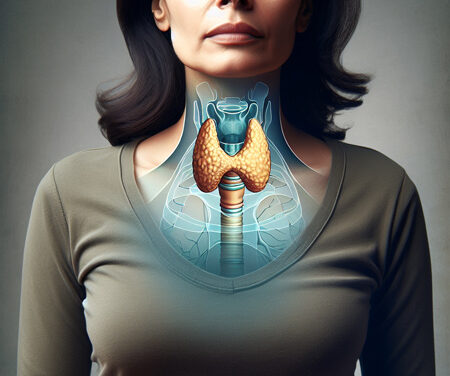
Another sign of a potential thyroid problem is a change in the thyroid gland itself. Located at the base of the neck, this butterfly-shaped gland may become swollen to the point that it is visibly enlarged.
Depending on the specific thyroid disease, most thyroid conditions can be successfully managed long term with thyroid medications and hormone therapies. Liothyronine is a medication that replaces T3 hormones if the body isn’t making enough T3 on its own. Levothyroxine is a medication that replaces natural T4 hormones if the body isn’t making enough of those. Natural desiccated thyroid (DTE) is made from dried pig thyroid glands.
Thyroid medications, including desiccated thyroid and levothyroxine, are available from Belmar Pharmacy in customizable dosage forms and strengths, to address hypothyroidism, hyperthyroidism, and other common thyroid disorders.
Belmar Pharmacy offers a variety of therapeutic options to support the body’s thyroid hormone balance. Compounded bioidentical forms of thyroid hormone replacement include synthetic T3/T4 options. Synthetic thyroid hormones are available as liothyronine sodium (T3) or levothyroxine sodium (T4). This form of thyroid hormone is biologically equivalent to the T3 and T4 in the human body, mimicking natural thyroid hormones. These active ingredients can also be compounded into combination oral formulations with both T3/T4.
The thyroid-stimulating hormone (TSH), is a hormone released by the pituitary gland. It tells the thyroid how much and when to release the hormones it produces called thyroxine (T4) and triiodothyronine (T3). If TSH doesn’t trigger the release of T3 and T4 from the thyroid gland, it can adversely affect metabolic, digestive, and heart functions.
There are many factors that can contribute to thyroid problems, including the pituitary gland’s ability to stimulate the thyroid to release its hormones into the body. The two most common thyroid problems are hypothyroidism (underactive thyroid) and hyperthyroidism (overactive thyroid). Several conditions can cause thyroid problems, including Hashimoto’s disease, a chronic autoimmune condition that can lead to an underactive thyroid.
Other conditions that may cause thyroid problems include iodine deficiency, Graves’ disease (the most common cause of hyperthyroidism), thyroid nodules, and thyroiditis.
Depending on whether a patient has hypothyroidism (underactive thyroid) or hyperthyroidism (overactive thyroid), they may experience opposite symptoms. If the thyroid is underactive, the patient may feel tired and cold, have a sluggish digestive system, feel depressed, and have trouble losing weight. When someone experiences hyperthyroid symptoms, they may feel anxious, lose weight quickly, have trouble sleeping, sweat easily, and have a faster heart rate. Either condition can cause an enlarged thyroid, or goiter, in the neck.
For women, hypothyroidism can mean heavier menstrual periods, and hyperthyroidism can contribute to irregular periods, or lack of them.
Depending on the type of thyroid medication taken, such as levothyroxine sodium, which is used to address hypothyroidism (underactive thyroid), too much thyroid medication may cause transient symptoms similar to those of hyperthyroidism (overactive thyroid). In this case, the patient may experience excessive sweating, rapid heartbeat, anxiety, diarrhea, weight loss, feeling jittery, shaking hands, and trouble sleeping.
Conversely, if the medication is addressing hyperthyroidism and the dose is too high, the patient may experience the opposite feelings of lethargy, lower heartbeat, feeling cold, depression, and mood swings.
Compounded thyroid replacement therapy allows for dose flexibility, combination therapy, and formulation adjustment. Liothyronine sodium (T3) and levothyroxine sodium (T4) can be combined into a single dosage form to improve ease of administration, and their strengths can be customized to meet individual patient needs. Compounded prescriptions can also be formulated to modify the release of the drug as well as to limit unnecessary fillers.
Proper thyroid function requires the conversion of T4, the primary inactive thyroid hormone, to T3, the body’s active thyroid hormone. Levothyroxine sodium (T4) has a naturally longer half-life. Liothyronine sodium (T3) has a shorter half-life, and patients in need of T3 support may benefit from a compounded modified release formulation. It is recommended to take thyroid hormone replacement therapy roughly 30 to 60 minutes before breakfast. Absorption tends to be higher on an empty stomach (at least 4 hours apart from food or supplements).